When Is It Worth Discussing Presbyopia Surgery?
Dr. Guillermo Enríquez TostadoNovember 21, 202610 min read

In this article
The presbyopia, known as “age-related farsightedness,” is a normal change associated with aging that often makes near vision more difficult after age 40 or 45. For many people, glasses remain a simple, appropriate, noninvasive option. In some cases, discussing presbyopia surgery may make sense when symptoms affect important activities, nonsurgical alternatives have already been tried, and the person understands that a procedure may reduce dependence on glasses but does not guarantee perfect vision or eliminate all risks.
First: What problem are you trying to solve?
Presbyopia develops because the natural lens loses flexibility and its ability to focus on nearby objects. It may appear as difficulty reading, needing to hold a cellphone farther away, eye fatigue, or headaches. Diagnosis is made through an ophthalmologic assessment, not just an informal reading test.
Before discussing surgery, it is helpful to clarify what symptoms you have and when they occur: reading, computer use, manual work, driving, sports, or nighttime vision. It is also important to distinguish presbyopia from other problems, such as astigmatism, farsightedness, cataract, dry eye, or retinal diseases.
The National Eye Institute explains that reading glasses, prescription glasses, and contact lenses are common treatments for presbyopia. Therefore, wearing glasses does not mean the problem is “getting worse” or that surgery is required.
When is it worth bringing this up?
A consultation about presbyopia surgery may be reasonable if several conditions are met, not just one:
- •Difficulty seeing up close repeatedly interferes with important activities.
- •Reading glasses, progressive lenses, bifocals, or contact lenses have been tried, and their limitations significantly affect daily life.
- •The person wants to reduce their dependence on glasses but understands they may still need them for some tasks.
- •Expectations are realistic, and the person is willing to accept possible visual effects, such as halos, glare, or reduced vision quality in certain conditions.
- •The health of the cornea, natural lens, retina, and optic nerve makes it possible to assess a procedure with a reasonable balance of benefits and risks.

The decision should not be based solely on age or on the promise of “seeing without glasses.” The American Academy of Ophthalmology notes that the choice of an intraocular lens to correct presbyopia should take into account both eye health and each person’s visual needs.
Which alternatives are worth trying or comparing?
Continuing to wear glasses may be the best decision for many people. Reading glasses may be enough if the main problem is seeing up close. Progressive or bifocal glasses may help when you need to switch between distance and near vision. Multifocal contact lenses or a monovision approach may also be considered in selected cases, although they require an adjustment period and do not always provide the same visual quality for every activity.
Surgical alternatives are not all the same. Depending on the assessment, the ophthalmologist may discuss corneal procedures or replacing the natural lens with an intraocular lens that has a particular optical design. For people with cataracts, surgery can treat the clouding of the natural lens and allow a choice among different types of intraocular lenses. For others, natural lens replacement may be considered for refractive reasons, even when cataracts are not the main concern.
LASIK surgery can correct some refractive errors, but the National Eye Institute warns that LASIK does not correct presbyopia by itself. Some surgical approaches aim to create monovision, with one eye focused more for distance and the other more for near vision. This may work for some people, but not everyone tolerates the difference between the two eyes.
What are the benefits and limitations of intraocular lenses for presbyopia?
Multifocal or extended depth-of-focus intraocular lenses can expand the range of vision and reduce the need for glasses after surgery. However, they do not necessarily restore the eye’s natural accommodation. Their performance also depends on eye anatomy, residual refractive error, the eye’s surface, and each patient’s visual demands.
- •Reading or progressive glasses: Possible benefits: No surgery is required, and they are usually a simple way to improve vision. Things to consider: Dependence on glasses, fogging, the need for a prescription change, or adjusting to progressive lenses.
- •Contact lenses: Possible benefits: They may reduce the need for glasses and be practical for some activities. Things to consider: They require an adjustment period and proper care, and may cause discomfort or complications if used incorrectly.
- •Monovision: Possible benefits: May reduce dependence on glasses at certain distances. Things to consider: May affect depth perception, contrast, or comfort; not everyone tolerates it.
- •Multifocal or extended depth-of-focus intraocular lens: Possible benefits: May improve functional vision at several distances and reduce dependence on glasses. Things to consider: May be associated with halos, glare, reduced contrast sensitivity, or difficulty adjusting.
- •Monofocal intraocular lens: Possible benefits: May provide predictable visual quality at a selected distance. Things to consider: Glasses are often needed for other distances, especially for reading.
In a review by the American Academy of Ophthalmology published in Ophthalmology, multifocal and extended depth-of-focus lenses showed greater spectacle independence than monofocal lenses in many studies. However, more visual phenomena and lower contrast sensitivity were also reported, especially under mesopic conditions. This illustrates that greater spectacle independence may involve accepting certain optical trade-offs.
Important questions to consider before deciding
A comprehensive assessment should help answer at least the following questions:
- •Is presbyopia really the main problem, or is there another eye condition?
- •Which activities are priorities: reading, working at screens, driving at night, or performing precision tasks?
- •Have you tried eyeglasses with the correct prescription, and do you know what limitation you hope to address?
- •How much dependence on glasses would be acceptable after surgery?
- •How would you tolerate halos, glare, reflections, or a possible decrease in contrast?
- •What would happen if the final prescription is not what you expected or if another procedure is needed?
The evaluation should also examine the ocular surface, cornea, intraocular pressure, retina, optic nerve health, and stability of your prescription. A preexisting eye condition does not always rule out surgery, but it may change the prognosis or make a presbyopia-correcting lens less appropriate.
What risks should be part of the discussion?
Natural lens replacement is intraocular surgery. In addition to the general risks of cataract surgery, infection, inflammation, corneal edema, increased eye pressure, retinal problems, lens displacement, or the need for another procedure may occur. The FDA patient information on cataract surgery states that risks exist regardless of the lens chosen.
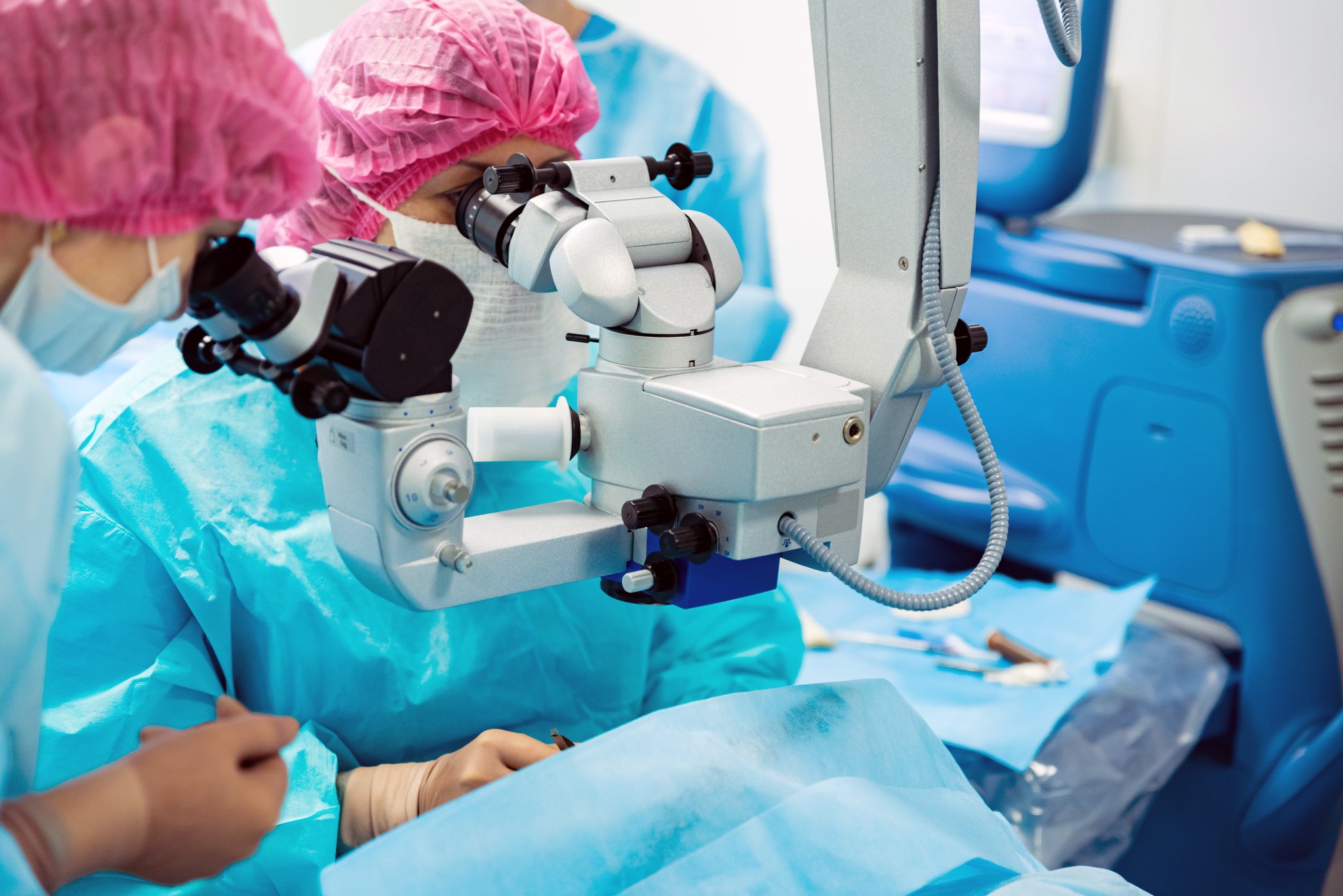
With multifocal or extended depth-of-focus lenses, some people may notice halos, flashes, blurred vision, or reduced visual quality, particularly at night. The review by the American Academy of Ophthalmology supports the finding that these effects are more common than with monofocal lenses in the comparative studies reviewed.
A residual prescription, dry eye, or difficulty adapting may also persist. A recent review of intraocular lens exchange describes how dissatisfaction may be related to residual refractive errors, ocular surface disease, changes in lens position, or difficulty adapting visually; therefore, lens exchange should not be assumed to be the first or best solution in every case.
Frequently asked questions
Does presbyopia surgery permanently eliminate the need for glasses?
Not necessarily. Some techniques and intraocular lenses may reduce dependence on glasses, but you may still need them for specific tasks, prolonged reading, low-light conditions, or after later changes in your vision.
Does being over 40 years old mean I should consider surgery now?
No. Age alone is not an indication for surgery. It is more important to understand how severe the symptoms are, which activities are affected, the health of your eyes, and how you respond to nonsurgical alternatives.
What if halos or glare bother me after surgery?
This should be discussed during your assessment and after surgery. These symptoms may be related to the type of lens, residual prescription, dry eye, or other factors. An evaluation is needed to identify the cause; these symptoms should not be considered an outcome that everyone must accept without a review.
talking does not mean deciding right away
The question “when to consider presbyopia surgery” does not have the same answer for everyone. It may be worth discussing when relying on glasses affects important activities, alternatives have already been evaluated, and the person understands both the potential benefits and the limitations and risks.
It is also completely valid to continue wearing glasses. The right option depends on eye health, visual priorities, tolerance for optical effects, and willingness to accept intraocular surgery. An individual assessment can help compare alternatives without making independence from glasses an obligation.
If you would like to review your options, you can request an ophthalmology consultation through this contact link. The consultation should help answer questions, review eye health, and determine whether there is a reasonable alternative, including the possibility of not having surgery.
References
- •
- •
- •
- •
- •
- •
This content is for informational purposes and does not replace a medical consultation or constitute a diagnosis.
This information is for guidance only and does not replace a medical consultation, diagnosis, or treatment. Each case is assessed in person.


